Choose a legal empty square
A new board starts with four discs in its centre. A turn adds one disc and must flip at least one opposing disc. You cannot drop a disc into an arbitrary gap or replace an occupied square. A move is legal because of the surrounding position, rather than because a square looks convenient.
Select an available move for your side. The computer responds when it has the turn and a legal option. Its decisions run locally in the browser. This is a single-player game against a computer, not a live matchmaking service or a room connecting two people on separate devices.
Follow a straight line to a friendly disc
Start at the square where you want to place your disc. Look horizontally, vertically and diagonally. A valid capture runs through one or more consecutive opposing discs and finishes at a disc already belonging to you. Those opposing discs flip when you make the move.
An empty square breaks the line. So does reaching your own disc before passing any opposing disc. You cannot jump across a gap or turn a corner halfway through a capture. A single placement can close several valid lines; all the opposing discs on those lines must turn over.
Check a small opening example
Our editorial diagrams label columns A through H and rows 1 through 8 from top to bottom. T marks your side and R the opponent. In the illustrated opening, C4 is a legal move: the new disc brackets the opposing disc at D4 against your existing disc at E4.
D4 is the only disc that flips in this example. Adding the new disc and changing D4 turns a two-to-two position into four discs against one. That count is useful feedback, but it is only a snapshot. It does not establish a winning position or prove that the biggest capture is best.
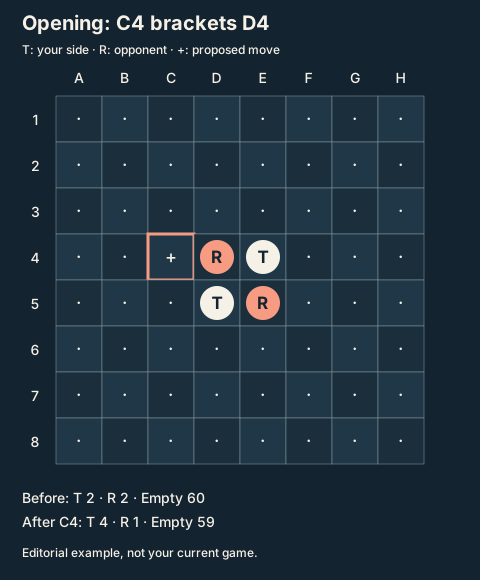
| Row | A | B | C | D | E | F | G | H |
|---|---|---|---|---|---|---|---|---|
| 1 | · | · | · | · | · | · | · | · |
| 2 | · | · | · | · | · | · | · | · |
| 3 | · | · | · | · | · | · | · | · |
| 4 | · | · | + | R | T | · | · | · |
| 5 | · | · | · | T | R | · | · | · |
| 6 | · | · | · | · | · | · | · | · |
| 7 | · | · | · | · | · | · | · | · |
| 8 | · | · | · | · | · | · | · | · |
A flipped disc can change hands again
Most discs are not permanently yours. On a later turn, the opponent can bracket and flip them back. In our worked continuation, an opposing move at C3 legally recaptures D4 along a diagonal. The count then becomes three discs on each side, even though the first capture looked promising.
Before choosing a move, consider the replies it allows. Look for a corner you might be offering, a useful empty square the opponent can reach, or a line you are making easy to capture. The local opponent uses a bounded decision rule; this page does not describe it as unbeatable or strategically perfect.
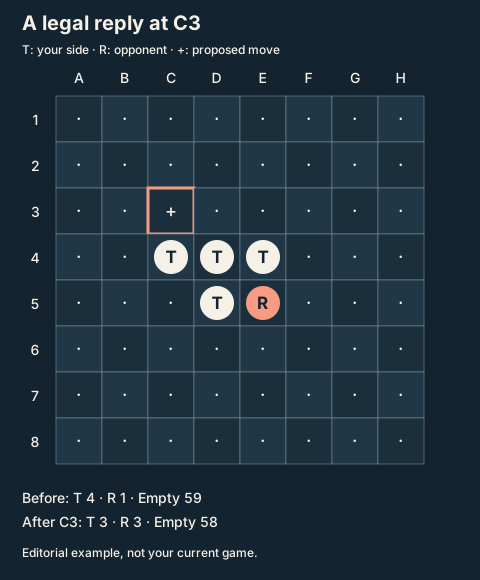
| Row | A | B | C | D | E | F | G | H |
|---|---|---|---|---|---|---|---|---|
| 1 | · | · | · | · | · | · | · | · |
| 2 | · | · | · | · | · | · | · | · |
| 3 | · | · | + | · | · | · | · | · |
| 4 | · | · | T | T | T | · | · | · |
| 5 | · | · | · | T | R | · | · | · |
| 6 | · | · | · | · | · | · | · | · |
| 7 | · | · | · | · | · | · | · | · |
| 8 | · | · | · | · | · | · | · | · |
Understand what a corner protects
A disc in a corner cannot be bracketed by a later move. There is no square beyond the edge to provide the other end of a capturing line. This makes a corner different from an ordinary edge square, although taking one does not automatically decide the result.
Do not assume the whole adjacent edge becomes safe as soon as you own a corner. Check the particular lines. Moves next to an empty corner deserve care because they may give the opponent access to it. Position and available replies matter more than a rule saying every edge move is good.
A forced pass is part of the game
If one side has no legal move, its turn passes to the other side. That opponent may play again if it still has an option. Passing is not a way to avoid an awkward choice: when a legal move exists, that side must play. The game handles the required turn changes.
Play ends when neither side can make a legal move. This can happen with empty squares still on the board. Count the discs actually present: the larger total wins and equal totals produce a draw. Empty squares are not extra discs awarded to the leader.
Practise one decision at a time
Use the guide for a longer worked sequence, or open the focused explanations of forced passes and multi-direction flips. Editorial boards are static demonstrations checked against the rules. They do not read your current position, replay the exact computer opponent or make a move on your behalf.
For your next round, try naming the friendly disc that closes each line before you select a square. Then look at the opponent’s possible reply. You can stop when your break is over; understanding a capture does not require finishing a match, protecting a streak or playing for a fixed amount of time.
Frequently asked questions
What makes a Reversi move legal?
An empty square must bracket at least one opposing disc in a straight line ending at a disc of your side.
Can I flip discs diagonally?
Yes. Captures are checked in all eight straight directions, including both diagonal orientations.
What if I cannot move?
Your turn passes if the opponent can still move. If neither side can move, the game ends.
Does the largest capture win?
No. The winner has the most discs when neither side has a legal move.
Is this online multiplayer?
No. This version uses a local computer opponent and does not provide live matchmaking or a multiplayer room.