Treat each direction as a separate line
Picture eight straight rays starting at the proposed square. For each ray, look for consecutive opposing discs followed by a friendly closing disc. One direction can succeed while another reaches a gap or the edge. You cannot join pieces of different rays to create a capture that bends around a corner.
When several lines qualify, you still add just one new disc. The opposing discs on all qualifying lines then flip. You do not get to choose only the horizontal capture or leave a bracketed disc unchanged because you dislike a possible reply.
Follow the F3 example
In this position, T can play F3. The leftward line brackets E3 and D3; the down-left diagonal also brackets E4. Three opposing discs therefore change hands from one placement. The resulting board has eleven T discs and two R discs, with fifty-one squares still empty.
The sample position follows eight legal placements from the starting board. It is an original two-side demonstration, not a screenshot or a sequence the local computer must reproduce. T and R identify the sides independently of the site’s colour theme.
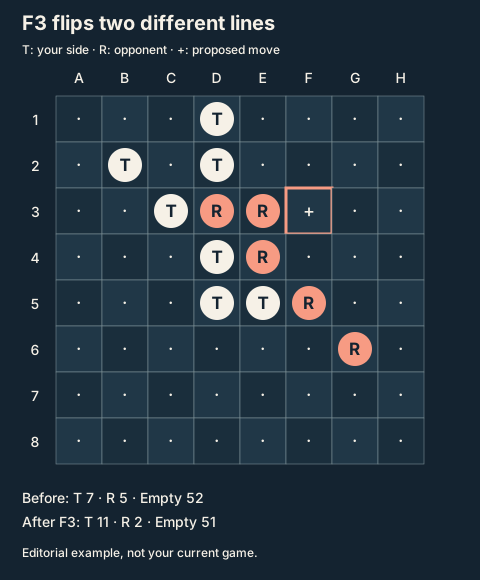
| Row | A | B | C | D | E | F | G | H |
|---|---|---|---|---|---|---|---|---|
| 1 | · | · | · | T | · | · | · | · |
| 2 | · | T | · | T | · | · | · | · |
| 3 | · | · | T | R | R | + | · | · |
| 4 | · | · | · | T | R | · | · | · |
| 5 | · | · | · | T | T | R | · | · |
| 6 | · | · | · | · | · | · | R | · |
| 7 | · | · | · | · | · | · | · | · |
| 8 | · | · | · | · | · | · | · | · |
Do not start another capture from E4
Once E4 flips, do not treat it as a second new placement that launches more captures from its own square. F3 is the origin for this turn’s lines. A pattern that only works by following a bent path does not add further flips to the move.
If your expected count differs from the result, separate the discs already on your side, the single disc you added and the opposing discs that flipped. The total number of occupied squares rises by one. The difference between the sides can change by more, because every flip adds to one side while subtracting from the other.
Name both closing discs for F3
The horizontal ray from F3 runs through E3 and D3 to a friendly disc at C3. The down-left diagonal runs through E4 to a friendly disc at D5. Naming those endpoints explains why both lines qualify. Merely pointing at three opposing discs near F3 would not establish that all three must flip.
The up-left diagonal from F3 instead reaches the empty square E2. That gap breaks the direction, whatever useful-looking discs may lie farther away. Checking a rejected ray is a useful way to understand the limit of the move, rather than searching only for lines that confirm your initial expectation.
Compare F3 with another legal option
F2 is also available to T in this position and flips E3. It captures one opposing disc, whereas F3 captures three. Before either move there are seven T discs and five R discs. F2 would leave nine T against four R; F3 leaves eleven T against two R.
These are alternatives, not successive actions on the same turn. Do not combine their resulting counts. The larger immediate capture at F3 does not prove that it is stronger against every future response. This comparison checks lines and counts; it is not an optimal-play analysis or an automatic move recommendation.
Explain the seven-disc change in the difference
Playing F3 occupies only one additional square. Each of the three flipped discs stops counting for R and starts counting for T. T therefore rises by four, R falls by three and the difference between their totals grows by seven. Seven new discs did not appear, and no multi-capture bonus was awarded.
As a consistency check, compare total occupancy before and after: twelve occupied squares become thirteen. Then count each side separately. This can reveal a missed diagonal or a newly placed disc counted twice. The visual changes and the stated totals should describe exactly the same position in this editorial example.
Frequently asked questions
Can I leave one valid line unchanged?
No. All opposing discs bracketed by the move’s valid lines must flip.
How many new discs does F3 add?
One. In the example, it also flips three discs already on the board.
Do flips spread from each newly changed disc?
No. Capturing rays start at the disc placed on this turn.
Where do I begin checking every capture?
At the disc placed on this turn. A disc that flips elsewhere does not become a new origin for another capture.
Why does F3 change the difference by seven?
One new disc adds one to T. Three flips each add one to T and remove one from R, making a total difference change of seven.