Use a three-part legality check
Start with an unoccupied square and look along one of its eight directions. The first disc in the line must belong to the opponent. Continue while consecutive opposing discs follow. To make a capture possible, the line must reach one of your discs before an empty square or the board’s edge.
A friendly disc immediately beside your proposed placement captures nothing, because no opposing disc lies between them. One opposing disc followed by a friendly closing disc is enough. A single valid direction makes the square legal, but every valid line from that placement must be resolved when the move is played.
Why C4 works and A1 does not in this position
Our opening places T at E4 and D5, and R at D4 and E5. With T to move, the legal squares are D3, C4, F5 and E6. C4 brackets D4 against E4. The corner A1 has no valid closing line yet; a desirable location is not automatically an available move.
Those options depend on the four stated discs and the side to move. Change the board or analyse R’s turn and you must check again. The coordinates belong to this editorial example. Its diagram does not inspect or give live advice about a round you have open elsewhere.
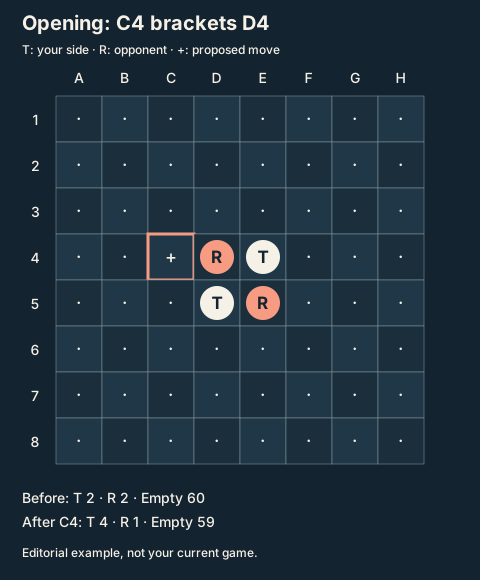
| Row | A | B | C | D | E | F | G | H |
|---|---|---|---|---|---|---|---|---|
| 1 | · | · | · | · | · | · | · | · |
| 2 | · | · | · | · | · | · | · | · |
| 3 | · | · | · | · | · | · | · | · |
| 4 | · | · | + | R | T | · | · | · |
| 5 | · | · | · | T | R | · | · | · |
| 6 | · | · | · | · | · | · | · | · |
| 7 | · | · | · | · | · | · | · | · |
| 8 | · | · | · | · | · | · | · | · |
What an empty legal-move list means
Check the directions carefully before concluding that no move exists. If your side genuinely has no valid capture, it must pass so that the opponent can continue if able. Only when neither side can move does play end. One blocked side is not enough to establish the finish.
As a small practice task, name the closing disc for two different opening moves. You do not need to choose the strongest move or memorise a sequence. The aim is to justify legality. The longer guide then follows an opposing reply and shows how a captured disc can change hands again.
Compare D3 and F5 as separate positions
Return to the starting diagram. T can play D3 by looking down through opposing D4 to friendly D5. T can also play F5 by looking left through opposing E5 to friendly D5. Both are legal, but they place the new disc on different squares and flip different existing discs.
Each option immediately leaves four T discs against one R disc. Equal totals do not make the boards identical: their distributions differ, so any opposing replies must be checked on the position actually produced. This exercise separates proof of legality and an immediate count from a full evaluation of future play.
Test an empty square that fails: F3
F3 is empty in the opening but is not one of T’s four legal choices. Looking down-left from F3 reaches E4, which is already friendly. No opposing disc has been crossed, so that direction captures nothing. Touching your own disc is not enough to make an otherwise empty square available.
The remaining directions also fail to complete a capture from F3 in this starting position. Its closeness to the centre creates no exception. One valid ray is sufficient to prove a move legal. Rejecting a square requires recognising that none of its eight rays satisfies the complete capture condition.
Switch sides before checking the reply
After T plays C4, evaluate the next move for R. Besides C3, R can use E3: the line runs through E4, now T, to E5, still R. Naming the side to move prevents you from reusing the previous player’s list simply because the board has only changed a little.
Try this check before consulting the highlighted choices: name the new square, the opposing disc in between and the friendly endpoint. If a part is missing, say which one. This is not a strongest-move calculation. It is a way to diagnose turns, gaps and closing discs without inventing extra features in the game.
Frequently asked questions
Is every square beside an opponent legal?
No. A friendly closing disc must complete the line without an empty square interrupting it.
Can I always play a corner?
No. A corner also needs a legal capture. A1 is unavailable to T in the illustrated opening.
Can a capture jump an empty square?
No. An empty square breaks that line.
Can I place a disc on an occupied square?
No. The placement must use an empty square and complete at least one valid capture.
Why do D3 and F5 have equal opening counts?
Each adds one disc and flips one opposing disc, leaving four against one. Their occupied squares differ, so their later replies must be evaluated separately.