The board’s geometry provides the protection
To flip a disc, the opponent must put it between a newly placed disc and a closing disc on the other end of a straight line. A corner has no squares beyond the edges. No line can run through that corner with usable board space on both sides, so an occupied corner cannot be captured.
An ordinary square partway along an edge is different. Its row or column may still have room on both sides. Check the relevant lines before calling it stable. Owning a corner does not make every nearby disc permanent if another placement can still bracket those discs.
Check a legal move at H8
Our example offers T a move at H8 that flips G7, F6, E5, D4 and C3 along the diagonal. The result is twenty-three T discs against eighteen R discs. T now owns the corner, but twenty-three squares remain empty and the game is still open.
The position has a legal move history. That lets you check the capture and count, rather than proving that H8 is the optimal choice against every reply. The example supplies no win probability and is not a recommendation calculated from a board you are currently playing.
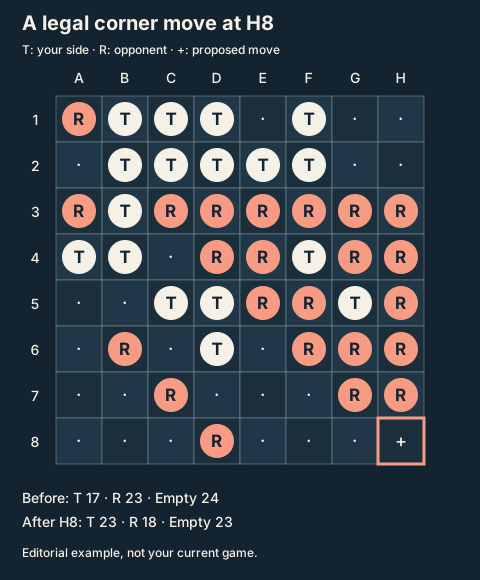
| Row | A | B | C | D | E | F | G | H |
|---|---|---|---|---|---|---|---|---|
| 1 | R | T | T | T | · | T | · | · |
| 2 | · | T | T | T | T | T | · | · |
| 3 | R | T | R | R | R | R | R | R |
| 4 | T | T | · | R | R | T | R | R |
| 5 | · | · | T | T | R | R | T | R |
| 6 | · | R | · | T | · | R | R | R |
| 7 | · | · | R | · | · | · | R | R |
| 8 | · | · | · | R | · | · | · | + |
Look at access before labelling a square good or bad
While a corner is empty, consider how your move would change the opponent’s access to it. A nearby placement may supply a line the opponent previously lacked. Examine the resulting board, rather than choosing solely by the number of discs your move would flip immediately.
Avoid both shortcuts: treating every edge as safe and rejecting every square near a corner without checking the position. Context matters. This page offers questions for comparing moves; it does not introduce a training mode, selectable difficulty level or automatic hint feature into the game.
Try G8 as an alternative on the same board
In the illustrated position, T can also play G8. That move flips G7 and G6, leaving twenty T discs against twenty-one R discs. It is not the same branch as taking H8 directly: H8 remains vacant after G8, and the set of available capturing lines has changed.
R can then place at H8 and flip G7, producing nineteen T against twenty-three R. This gives a concrete example of corner access offered by the alternative. Rather than guessing which squares are risky because they look near an edge, follow the placement, the opposing disc and the closing endpoint in this position.
Do not invent extra flips in that reply
In the exercise’s R move at H8, G7 flips. The disc T placed at G8 does not flip on that same turn. Being beside a newly occupied corner does not automatically change a disc’s side. Every flip in this area still needs its own valid straight capturing line.
This distinction separates a strategic warning from a game rule. Saying that a placement allowed access to H8 does not mean every nearby disc disappears immediately. To analyse a continuation, preserve all unchanged symbols and update only the newly occupied square and the captures that the actual move brackets.
Compare branches without claiming perfect play
Treat H8 and G8 as two branches from this article’s starting position. Record the new square, flipped discs and resulting counts for each. In the G8 branch, then add the legal reply at H8. Keep the histories separate so that discs from one possible continuation do not accidentally migrate into the other.
The exercise shows why it helps to check opposing access instead of counting only immediate flips. It does not establish that a corner is always the best possible decision, nor replace a search of every continuation. Its purpose is to justify a warning with a concrete board rather than memorising a universal ban on particular edge squares.
Frequently asked questions
Can a disc in a corner be flipped?
No. A corner cannot lie between the two valid endpoints of a capturing line.
Is every edge disc stable?
No. Some edge discs can still be bracketed along their row or column.
Does playing H8 guarantee a win?
No. The example proves a legal capture, not a future match result.
Does the G8 disc flip automatically when R takes H8?
No. In this example the H8 reply flips G7 only. A nearby disc changes only if the actual placement brackets it legally.
Can I take H8 at the start of the game?
Not in the illustrated opening. A corner must satisfy the same capture requirement as every other empty square.