Both sides must be unable to play
It is not enough for the side to move to be blocked. If the opponent retains a legal capture, a pass lets that side continue. The ending condition requires both legal-move lists to be empty. That rule allows a match to finish properly even with some squares still vacant.
A full board also leaves neither side a square for another placement. The result belongs to that final position. Earlier large captures, the number of turns a side spent ahead and unused squares do not contribute bonus points to the score.
Check an ending with sixty-three discs
Our terminal example contains fifteen T discs, forty-eight R discs and one empty square. Neither side can use that last space to bracket opposing discs. The game is over and R wins by the larger total. The vacant square stays vacant; it is not turned into a forty-ninth opposing disc.
A legal sequence, including any required passes, leads to this position. The example checks the ending rule and count. It is not a recent player’s result or a forecast for your round. Letters identify the sides independently of the colour theme used on the site.
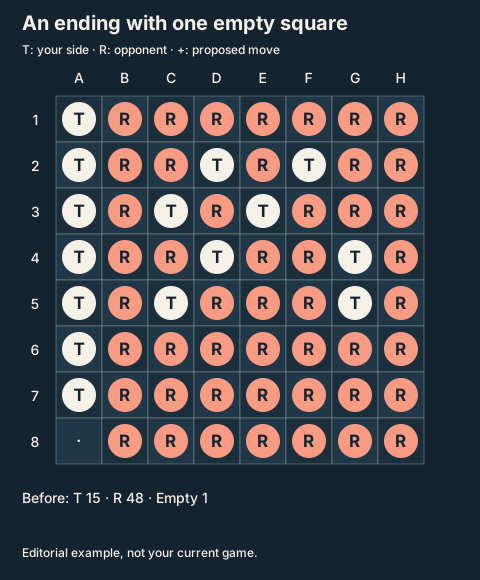
| Row | A | B | C | D | E | F | G | H |
|---|---|---|---|---|---|---|---|---|
| 1 | T | R | R | R | R | R | R | R |
| 2 | T | R | R | T | R | T | R | R |
| 3 | T | R | T | R | T | R | R | R |
| 4 | T | R | R | T | R | R | T | R |
| 5 | T | R | T | R | R | R | T | R |
| 6 | T | R | R | R | R | R | R | R |
| 7 | T | R | R | R | R | R | R | R |
| 8 | · | R | R | R | R | R | R | R |
Verify a draw rather than judging its appearance
Our second example has thirty-two T and thirty-two R discs, no empty squares and no available moves. Because play has finished with equal totals, it is a draw. The rules do not add a special disc, a score bonus or a sudden-death placement merely to force a winner.
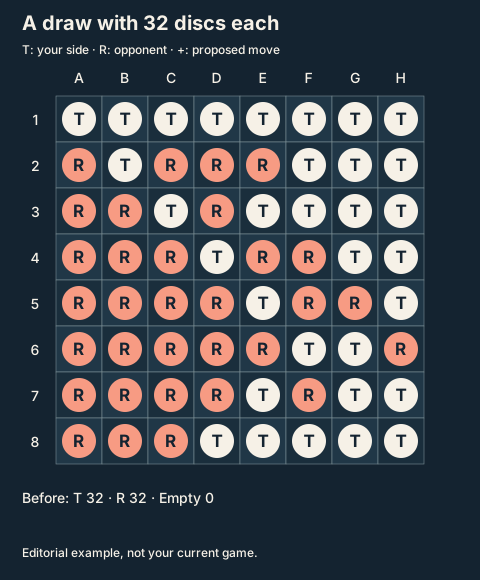
| Row | A | B | C | D | E | F | G | H |
|---|---|---|---|---|---|---|---|---|
| 1 | T | T | T | T | T | T | T | T |
| 2 | R | T | R | R | R | T | T | T |
| 3 | R | R | T | R | T | T | T | T |
| 4 | R | R | R | T | R | R | T | T |
| 5 | R | R | R | R | T | R | R | T |
| 6 | R | R | R | R | R | T | T | R |
| 7 | R | R | R | R | T | R | T | T |
| 8 | R | R | R | T | T | T | T | T |
Investigate a surprising final count
Count each side’s symbols and confirm that discs plus empty squares total sixty-four. To review the last move, distinguish the single new disc from opposing discs that changed hands. Only one extra square became occupied. Each flip subtracts from one side while adding to the other, which is why the difference can change by more than one.
Explain why A8 cannot be used here
The terminal diagram’s only empty square is A8. Looking up reaches A7 through A1, all T. Looking right reaches B8 through H8, all R. The up-right diagonal also contains only R through H1. Every other direction leaves the board immediately from this corner.
For T, the vertical direction meets a friendly disc first and captures nothing; the other two rays run through opponents to the edge without a friendly endpoint. For R, those two rays begin with friendly discs, while the vertical line runs through T to the edge without closing. This checks the absence of moves, rather than relying only on a displayed count.
Use three quantities that total sixty-four
Fifteen T discs, forty-eight R discs and one vacant square total sixty-four. That is a useful check that no square was omitted, but does not by itself prove the round has ended. You must separately establish that neither side has a legal placement.
In the draw example, thirty-two plus thirty-two also totals sixty-four, this time with no vacancies. Every square is occupied, so none can accept another disc. These two positions illustrate different valid endings: a full board, or an incomplete board on which neither side can move.
Do not add up historical captures as bonus points
The same disc may have changed sides several times during the round. The final result does not add those historical flips as extra points. Each present disc counts once for the side it shows at the finish. Adding only the memorable captures you recall cannot reconstruct the winner reliably.
To inspect the last change, return to the position before that placement and separate the new disc, flips and any passes. Passing changes no count. A placement adds one disc and turns the bracketed opposing discs. That review can explain a surprising difference without inventing scoring bonuses that this version does not award.
Frequently asked questions
Can a match end with a vacant square?
Yes. The 15–48 example ends because neither side can legally use the remaining square.
Who gets the empty squares?
Neither side. The count includes actual discs; vacant squares are not awarded to the winner.
When is the result a draw?
When play has ended and both sides have the same number of discs.
Do earlier flips count as extra points?
No. Each disc counts once for the side it belongs to at the finish, regardless of how often it changed sides.
Does fifteen plus forty-eight and one empty square prove the game has ended?
It accounts for all sixty-four squares, but does not prove the ending by itself. Both sides must also have no legal move.