Passing depends on legality, not preference
You cannot pass simply because the available choices look unattractive. If an empty square brackets an opposing disc against one of your discs, your side has a legal move and must play. If no square satisfies that condition, the turn passes to the other side.
The local game resolves that transition as part of the round. Seeing the opponent play again is not, by itself, proof of an extra-turn error. First check whether your side was unable to make any valid capture, then establish whether the opponent still had a legal option.
Two empty squares, but only one side can play
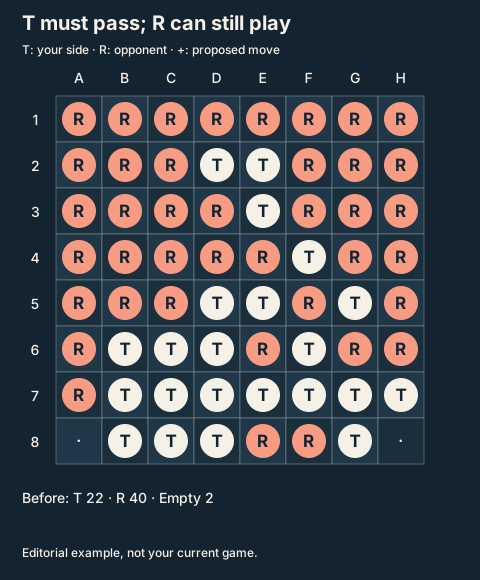
Our example has twenty-two T discs, forty R discs and two empty squares. T’s legal-move list is empty. R can play A8 or H8. The correct transition is therefore a pass from T to R, rather than ending the game or inventing an otherwise illegal placement for T.
The counts help identify the position but do not cause the pass. In a different position, the side with more discs could be the one unable to move. What matters is the ability to bracket at least one opposing disc legally, not whether a side is ahead, behind or close to filling the board.
| Row | A | B | C | D | E | F | G | H |
|---|---|---|---|---|---|---|---|---|
| 1 | R | R | R | R | R | R | R | R |
| 2 | R | R | R | T | T | R | R | R |
| 3 | R | R | R | R | T | R | R | R |
| 4 | R | R | R | R | R | T | R | R |
| 5 | R | R | R | T | T | R | T | R |
| 6 | R | T | T | T | R | T | R | R |
| 7 | R | T | T | T | T | T | T | T |
| 8 | · | T | T | T | R | R | T | · |
Check the separate condition for finishing
After a move or pass, reassess the available options. If neither side can move, the round is over, even when some squares remain empty. The final result then compares the discs actually present and can be a win, a loss or a draw.
Do not fill an empty square illegally to make the board look finished or add a tie-break round that the rules do not require. As a practice question, explain why the opponent can use A8 in the example while T cannot. The same vacant square can be legal for one side and unavailable to the other.
Follow one of the opponent’s available choices
Choose A8 for R in the diagram. The move flips B7, C6 and D5 diagonally, plus B8, C8 and D8 horizontally. Adding the A8 disc and changing those six opposing discs leaves sixteen T against forty-seven R, with one square still empty.
T still has no legal move, while R can use H8. This continuation therefore requires another pass by T. It is not an endless repetition of the same position: each legal opposing placement occupies another empty square. The absence of a T reply does not permit an illegal placement to balance the number of turns.
Keep empty space, turn and legality separate
A8 was empty for both sides in the initial example, but only R could use it. T had no opposing line ending at a friendly closing disc from that square. R did. Two sides can therefore examine the same vacant square and have different legal options.
When checking a pass, do not infer legality from available space alone. Name the side to move and inspect its eight directions from each candidate. Then evaluate the other side. That second check determines whether play continues or ends; a count of vacant squares cannot replace it.
Reconstruct the turn without adding a special rule
To study the sequence, record three states: before the pass, after R plays A8 and after the remaining options are checked. In the second state, one square is empty, T cannot move and R can. That combination explains the next turn without a compensation move, rematch rule or special endgame exception.
A pass adds no disc and changes no disc’s side by itself. Those changes belong to the legal placements around it. In your next round, you can test this idea in one situation and stop when your break ends. You do not need to force repeated matches until an identical example appears.
Frequently asked questions
May I pass when I have a legal move?
No. A pass is required only when your side has no legal capture.
Can the opponent play twice in succession?
Yes, if your side has no legal move between those turns.
Do two empty squares guarantee more play?
No. At least one side must still have a legal move.
Does a pass change the disc count?
No. Passing places no disc and flips none. Only a legal placement changes the board.
Can the same side be forced to pass more than once?
Yes. After each opposing move, check both sides again. Another pass is required if that side still has no legal move while the opponent has one.